Skip to content
Table of Contents
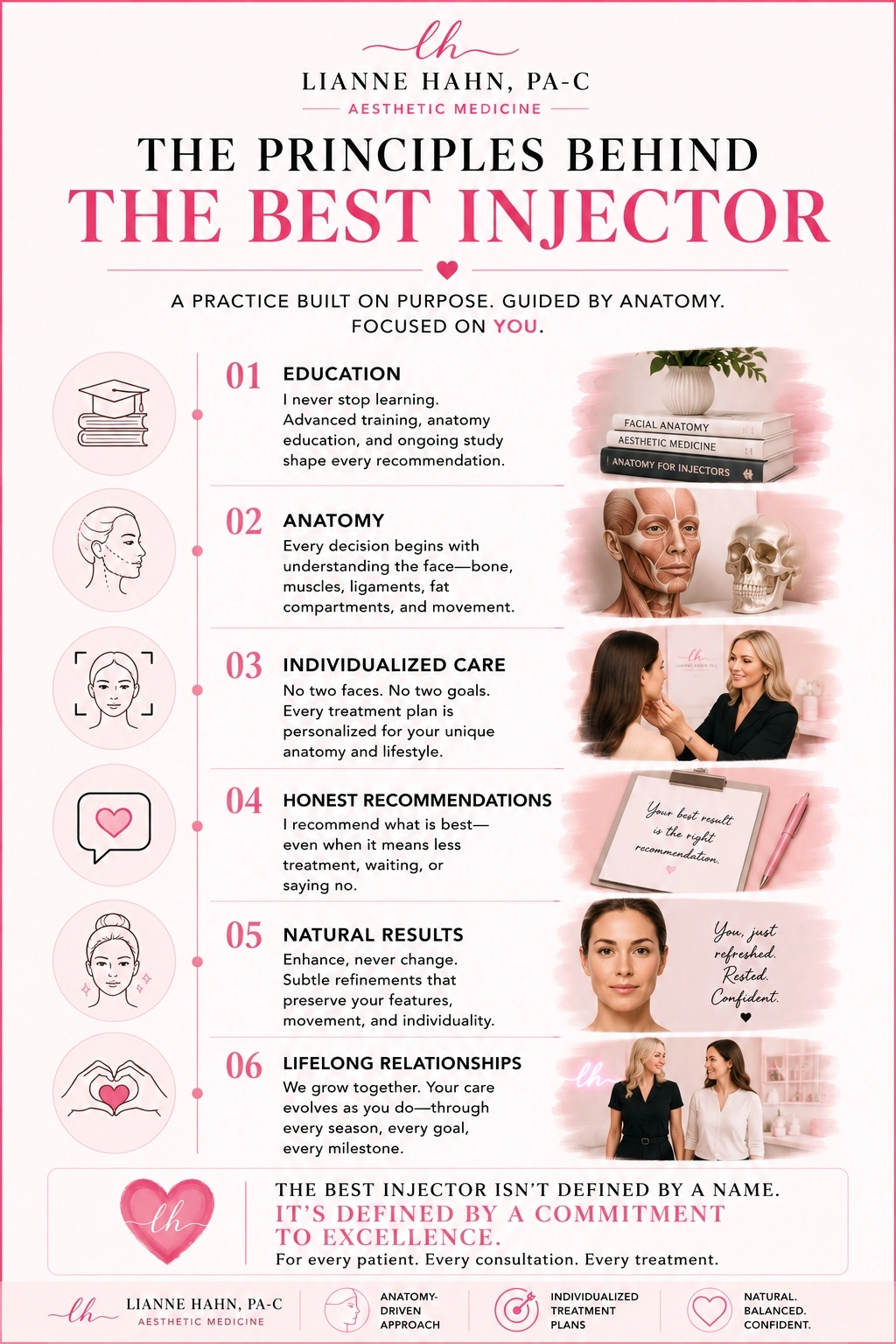
Great Medicine Never Stops Learning
One of the questions I hear most often is, “How do you stay current with everything that’s constantly changing in aesthetics?”
The answer is simple.
I never stop learning.
Aesthetic medicine is one of the fastest-evolving areas of healthcare. Every year, new research, updated safety recommendations, improved injection techniques, evolving facial anatomy concepts, and innovative technologies continue to shape how we care for patients.
Graduating from a medical program and earning professional credentials are only the beginning of a career—not the end of education.
My commitment to continuing education is one of the most important investments I make in my patients because every new skill, every anatomy course, every conference, and every mentorship ultimately improves the quality of care I provide.
Medicine Is Constantly Evolving
Healthcare is never static.
As our understanding of facial aging continues to improve, so do treatment techniques.
We now understand far more about:
- Facial fat compartments
- Retaining ligaments
- Bone remodeling
- Collagen loss
- Facial vascular anatomy
- Product rheology
- Long-term treatment planning
- Patient safety
Many of the techniques commonly used today did not exist when I first entered medicine.
Remaining current means remaining teachable.
Continuing Education Improves Patient Safety
One of the greatest benefits of ongoing education is improved patient safety.
Advanced anatomy courses help providers better understand:
- Blood vessel pathways
- Anatomical danger zones
- Safer injection planes
- Product selection
- Complication recognition
- Evidence-based treatment strategies
Every educational opportunity contributes to making aesthetic treatments safer and more predictable.
Safety is never something that should be assumed—it should be continually refined through education and experience.
Learning From the Leaders in Aesthetic Medicine
One of the aspects of my career I value most is the opportunity to train with internationally recognized leaders in aesthetic medicine.
Rather than relying solely on lectures or online education, I have sought hands-on mentorship from physicians and educators who have helped shape modern aesthetic practice.
My advanced training has included education with internationally respected experts such as:
- Julie Horne
- Tom Van Eijk
- Sebastian Cotofana
- Christopher Surek
- Arthur Swift
Each educator has contributed a unique perspective on anatomy, facial assessment, patient safety, and natural aesthetic outcomes.
Learning directly from experienced leaders allows me to continually refine my techniques while bringing evidence-based practices back to my patients.
Cadaver Anatomy Changes the Way You Inject
There is no substitute for understanding human anatomy firsthand.
Cadaver anatomy training provides an opportunity to study:
- Facial arteries
- Veins
- Muscles
- Retaining ligaments
- Fat compartments
- Nerve pathways
- Skeletal support
This level of education strengthens the connection between textbook anatomy and real-world patient care.
It reinforces why every injection should be guided by anatomy rather than routine.
Continuing Education Is More Than Collecting Certificates
Patients sometimes see certificates displayed in an office and assume continuing education is simply about accumulating credentials.
For me, it has always been about becoming a better clinician.
Every course prompts me to ask questions such as:
- Can this improve patient safety?
- Will this create more natural results?
- Does the evidence support this technique?
- How can I improve my consultation process?
- What can I bring back to my patients?
Education only has value when it changes the way we care for people.
Conferences Encourage Collaboration
One of the greatest advantages of attending national conferences is learning from other experienced providers.
Medicine advances through collaboration.
Discussing challenging cases, reviewing emerging research, sharing techniques, and hearing different perspectives encourages continual improvement.
No single provider has every answer.
Remaining open to learning from others benefits every patient we treat.
Evidence Should Guide Every Decision
Social media has made aesthetic medicine more visible than ever before.
Unfortunately, popularity does not always equal good medicine.
New techniques appear online every day.
Some become valuable additions to patient care.
Others fade quickly because they lack scientific support.
My approach is to evaluate new ideas through:
- Peer-reviewed literature
- Anatomy
- Clinical experience
- Patient safety
- Long-term outcomes
Evidence—not trends—should guide treatment decisions.
Education Improves Every Consultation
Patients often assume continuing education only changes how injections are performed.
In reality, it also improves communication.
Every course expands my ability to:
- Explain anatomy
- Educate patients
- Set realistic expectations
- Develop individualized treatment plans
- Recognize when treatment is not appropriate
The consultation becomes stronger because the knowledge behind it becomes deeper.
Why Lifelong Learning Matters to My Patients
Every hour invested in education ultimately benefits the patient sitting in my chair.
It influences:
- Consultation quality
- Treatment planning
- Product selection
- Injection technique
- Safety
- Natural-looking outcomes
- Long-term patient care
Patients deserve a provider who remains curious, continues asking questions, and actively seeks opportunities to improve throughout an entire career.
Education Supports Individualized Care
No two faces are identical.
The more knowledge we gain about anatomy, aging, facial proportions, and treatment planning, the better we become at creating individualized recommendations.
Education allows treatment plans to move beyond protocols and become personalized.
That is one of the reasons I continue investing in advanced education year after year.
Clinical Insight from Lianne Hahn
“One of the greatest lessons I’ve learned is that confidence should never replace curiosity. The more I learn about anatomy and facial aging, the more thoughtful my treatment planning becomes. Continuing education isn’t about collecting certificates—it’s about providing better care for every patient who trusts me.”
My Philosophy
Continuing education is not optional in aesthetic medicine.
It is a professional responsibility.
Every patient deserves a provider who remains committed to learning, refining technique, evaluating new evidence, and continually improving.
Medicine evolves.
Research evolves.
Techniques evolve.
My commitment to education evolves with them.
Conclusion
Exceptional aesthetic medicine is built upon a foundation of lifelong learning.
Every conference attended.
Every anatomy course completed.
Every mentorship.
Every scientific publication reviewed.
Every discussion with respected colleagues.
Together, these experiences shape safer procedures, more thoughtful consultations, and natural-looking outcomes that place patient care above everything else.
For me, continuing education has never been about earning another certificate.
It has always been about becoming a better clinician.
References
- American Society of Plastic Surgeons. Educational resources on facial rejuvenation and aesthetic surgery.
- American Society for Dermatologic Surgery. Continuing education resources and patient safety guidance.
- Cotofana S, et al. Facial anatomy and danger zones in injectable aesthetics. Aesthetic Surgery Journal.
- Surek C, et al. Contemporary facial anatomy and its application in aesthetic medicine.
- Rohrich RJ, Pessa JE. Facial fat compartments and facial aging. Plastic and Reconstructive Surgery.
- Akinbiyi T, et al. Better Results in Facial Rejuvenation with Fillers. Plastic and Reconstructive Surgery Global Open.
Experience an Anatomy-Based Approach to Aesthetic Medicine
Every patient deserves care guided by education, anatomy, and evidence—not trends. Learn more about the personalized treatments available through The Best Injector.