Skip to content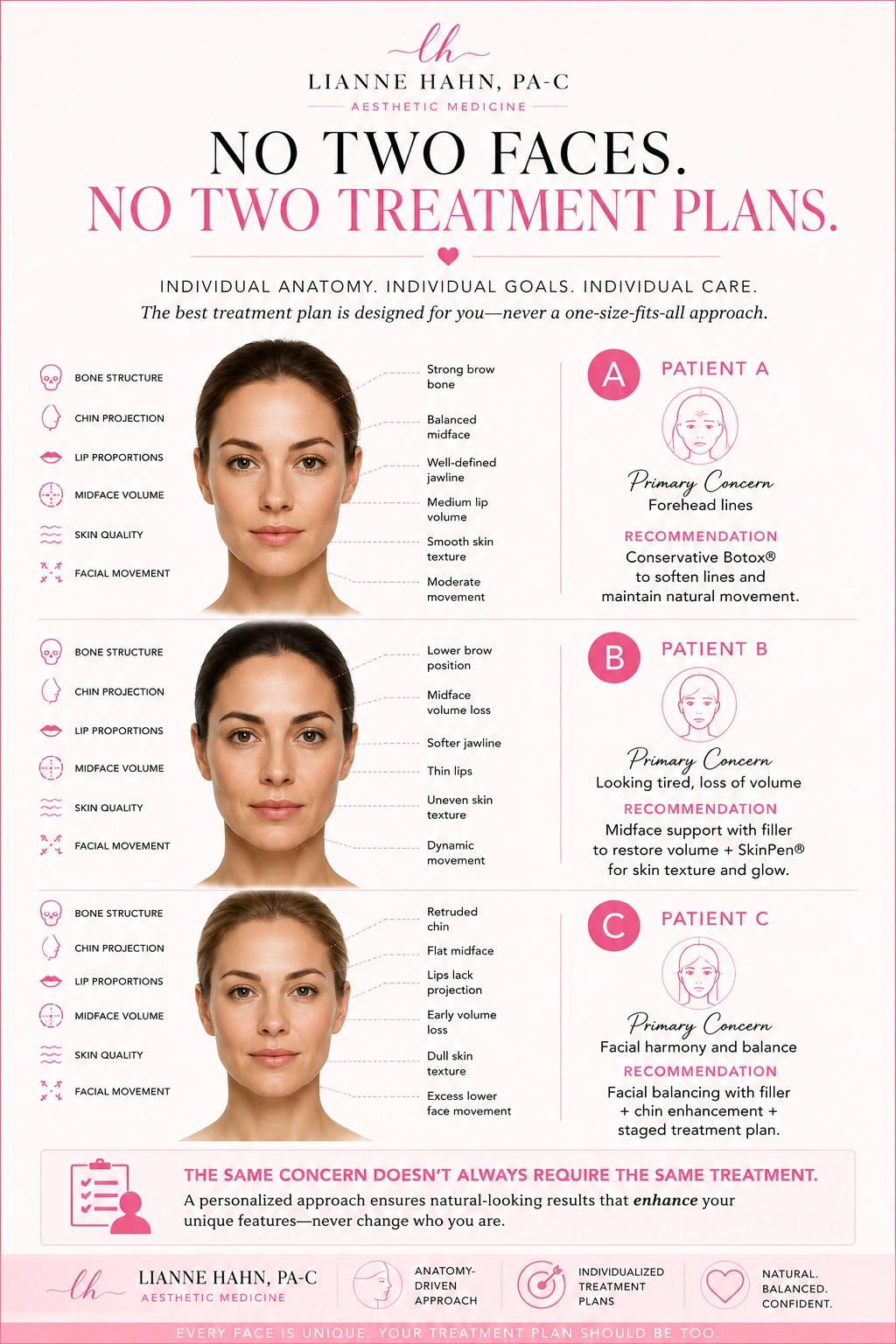
Table of Contents
There Is No Universal Formula for Beautiful Results
One of the most common misconceptions in aesthetic medicine is that every patient with the same concern should receive the same treatment.
If two people have forehead lines, they must need the same amount of Botox®.
If two people want fuller lips, they should receive the same filler.
If two patients have smile lines, they need the same number of syringes.
In reality, aesthetic medicine simply doesn’t work that way.
Every face is different.
Every anatomy is different.
Every patient has different goals, priorities, medical history, lifestyle, and expectations.
Because of that, I believe every treatment plan should be individualized from the very beginning.
Beautiful, natural-looking results are created by treating the person—not following a formula.
No Two Faces Age the Same Way
Although aging is universal, the way each person ages is remarkably unique.
Genetics, facial anatomy, collagen production, bone remodeling, sun exposure, lifestyle, weight fluctuations, and muscle movement all influence the aging process.
Some patients lose cheek volume early.
Others develop stronger expression lines.
Some experience skin laxity first.
Others notice changes in the jawline or neck.
Treating everyone identically ignores those important differences.
The Consultation Is Where Personalization Begins
An individualized treatment plan starts long before any injection is performed.
Every consultation should answer several important questions:
- What concerns brought the patient in?
- What are their long-term goals?
- What treatments have they had previously?
- What is their medical history?
- How does their face move naturally?
- Which concerns should be prioritized first?
Only after those questions are answered can an appropriate treatment plan begin to take shape.
Every consultation at The Best Injector begins with a comprehensive facial assessment designed to develop an individualized treatment strategy based on anatomy rather than assumptions.
Facial Anatomy Guides Every Recommendation
One of the most important reasons treatment plans differ is because facial anatomy differs.
During every consultation I evaluate:
- Skeletal support
- Facial proportions
- Chin projection
- Jawline definition
- Midface support
- Skin quality
- Dynamic muscle movement
- Volume loss
- Overall facial harmony
These findings influence whether treatment is appropriate, which areas deserve attention first, and whether multiple treatments should be staged over time.
Patient Goals Matter Just as Much as Anatomy
Two patients with nearly identical anatomy may still receive completely different treatment recommendations.
Why?
Because their goals are different.
One patient may want preventative treatment.
Another wants subtle rejuvenation.
Someone else wants structural support.
Others simply want to look less tired.
Listening carefully is just as important as evaluating anatomy.
The best treatment plan reflects both objective findings and personal priorities.
Conservative Treatment Is Often the Best Treatment
Individualized care also means recognizing when less treatment is appropriate.
Some patients benefit from gradual improvements over several appointments.
Others need only one small adjustment.
Sometimes the best recommendation is to wait.
Sometimes it is to avoid treatment altogether.
There is no benefit in recommending more treatment simply because it is available.
This philosophy is one of the reasons I frequently recommend facial balancing, where treatment decisions are based on overall harmony rather than isolated features.
One Treatment Rarely Solves Every Concern
Patients often arrive requesting treatment for one specific area.
However, aesthetic concerns frequently have underlying causes elsewhere.
For example:
- Smile lines may be influenced by cheek support.
- Lip proportions may relate to chin projection.
- A prominent nose may appear more balanced after improving the chin.
- Under-eye concerns may be related to midface volume loss.
Looking at the face as a complete system often produces more elegant, natural-looking results than treating one feature alone.
Lifestyle Influences Treatment Planning
An individualized treatment plan also considers the patient’s lifestyle.
Factors such as:
- Exercise habits
- Sun exposure
- Skin care routine
- Occupation
- Downtime preferences
- Budget
- Upcoming events
may all influence treatment recommendations and scheduling.
Medicine should fit the patient—not the other way around.
Long-Term Planning Creates Better Outcomes
I rarely think about today’s appointment alone.
Instead, I think about where a patient wants to be one year from now… and even five years from now.
Gradual treatment planning often creates more natural results than trying to accomplish everything in one visit.
Long-term planning also allows recommendations to evolve as anatomy and goals naturally change.
Individualized Care Means Saying “No”
Personalized medicine isn’t only about recommending treatments.
It’s also about recognizing when treatment isn’t appropriate.
Sometimes expectations are unrealistic.
Sometimes anatomy suggests another approach.
Sometimes another provider or procedure would better serve the patient’s goals.
Those conversations are part of responsible medical care.
Clinical Insight from Lianne Hahn
“One of the reasons I enjoy aesthetic medicine is that no two consultations are ever exactly alike. Every patient teaches me something new about anatomy, aging, and personal goals. That individuality is what makes personalized treatment planning so rewarding—and why no two treatment plans should ever be identical.”
My Philosophy
Every recommendation I make begins with one question:
What is best for this individual patient?
Not:
What is trending?
What did someone else receive?
What package fits best?
Medicine should never be one-size-fits-all.
Aesthetic medicine should be no different.
Conclusion
Individualized treatment planning is one of the most important factors in achieving safe, natural-looking results.
Every patient’s anatomy, goals, lifestyle, and aging process are unique.
When those differences are respected through thoughtful consultation and anatomy-based planning, cosmetic treatments become more balanced, more conservative, and more personal.
For me, individualized care isn’t a marketing phrase.
It’s the foundation of every recommendation I make.
References
- American Society of Plastic Surgeons. Patient education on individualized facial rejuvenation.
- American Society for Dermatologic Surgery. Cosmetic injectables and patient assessment.
- Cotofana S, et al. Facial anatomy and aesthetic treatment planning. Aesthetic Surgery Journal.
- Rohrich RJ, Pessa JE. Facial aging and individualized facial rejuvenation. Plastic and Reconstructive Surgery.
- Akinbiyi T, et al. Better Results in Facial Rejuvenation with Fillers. Plastic and Reconstructive Surgery Global Open.
Experience a Personalized Consultation
Every face is different, and every treatment plan should be too. Learn more about the individualized aesthetic treatments available through The Best Injector.